HOME
PROJECT_ORIGIN: NSDUH / SAMHSA ANALYTICS
HYPOTHESIS: ACCESS DECREASES EMPLOYMENT BARRIERS
VECTOR_ANALYSIS: CROSS-TABULATING 50 FEDERAL STATES
STAT_METHOD: CHI-SQUARE INDEPENDENCE TEST
P-VALUE: < 0.001 (STATISTICALLY SIGNIFICANT)
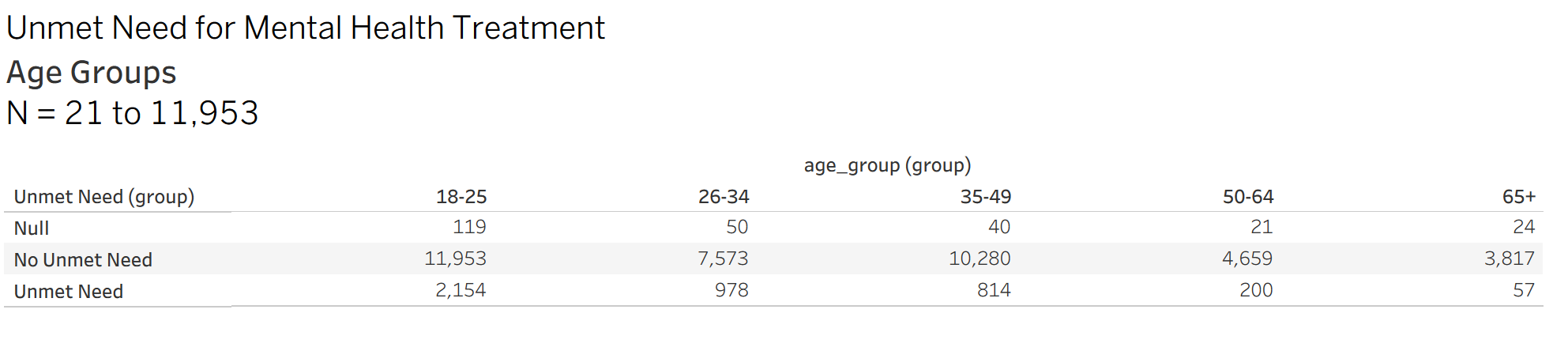
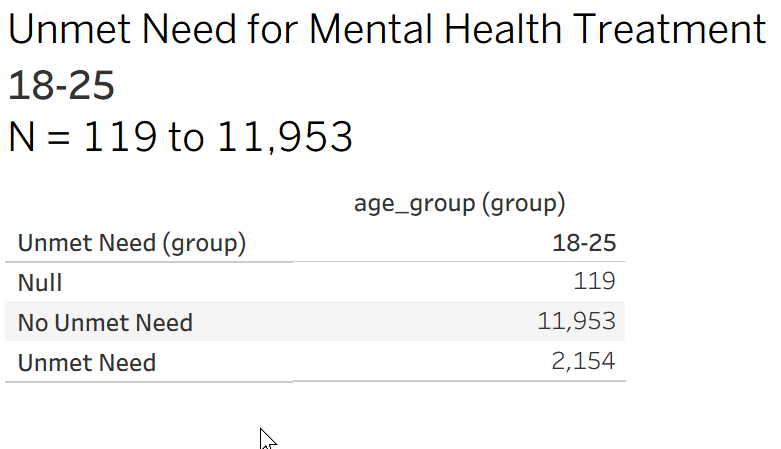
COHORT: n = 15,780 (ADULTS 18–25)
STATUS: NULL_HYPOTHESIS REJECTED // DEPLOYED
PROJECT_ORIGIN: NSDUH / SAMHSA ANALYTICS
HYPOTHESIS: ACCESS DECREASES EMPLOYMENT BARRIERS
TIMESTAMP SYS.STATUS: [ACTIVE]

sql_mini_mentalhealth

RESEARCH PIPELINE // CONCEPTION TO CONCLUSION
Stage 01 01
THE QUESTION
Does failing to treat mental health needs cause measurable workforce detachment?
Stage 02 02
THE DATA
2019 NSDUH / SAMHSA dataset.
Focal cohort: n=15,780 (Adults 18–25).
Variables: AMHTXND2, IRWRKSTAT.
Stage 03 03
THE TEST
Chi-Square Test of Independence. PostgreSQL ETL pipeline. Schema normalization across survey years.
Stage 04 04
THE RESULT
p < 0.001 — Statistically Significant.
Full-time employment drops ~67% → ~61% when unmet need is present.
Stage 05 05
THE CONCLUSION
Null Hypothesis Rejected.
Unmet mental health need = measurable, catastrophic workforce detachment.
SAMHSA // NSDUH // 2019
EMPLOYER VALUE // HEALTHCARE DATA ANALYTICS

Every phase of this study maps directly to the skills healthcare analytics organizations depend on. Defining a testable hypothesis from a complex federal dataset mirrors the clinical question framing required for HEDIS measure analysis and CMS quality reporting. Building ETL pipelines to resolve schema drift across NSDUH survey years is the same discipline applied to normalizing inconsistent EHR exports, payer claim formats, and ICD-10/CPT code structures across systems. Chi-Square independence testing is directly applicable to denial pattern analysis—determining whether denial rate is statistically dependent on payer type, service line, or coding practice. Translating codebook variables into readable nomenclature for non-technical stakeholders is exactly what RCM teams need when surfacing A/R aging trends or clean claim rates to CFO-level audiences. The full arc demonstrated here—question, pipeline, validation, insight, communication—is the complete workflow of a productive healthcare data analyst.

THE DATA STORY // SWIPE OR DRAG TO VIEW
1 / 7
The Problem
01 // THE_PROBLEM
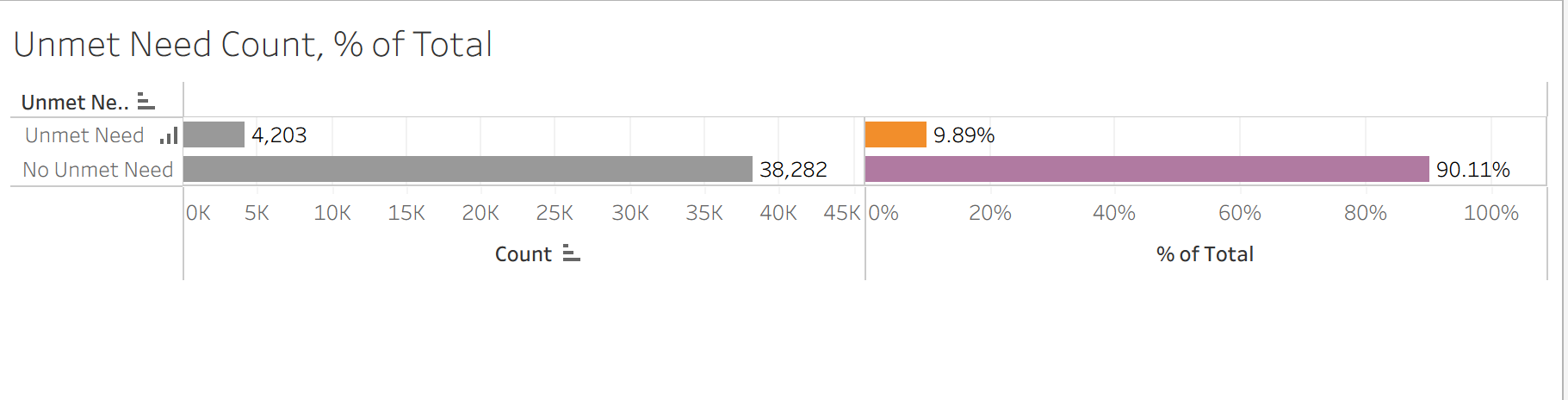
Millions of adults experience unmet mental health needs. What is the downstream economic impact of failing to provide care?
The Data
02 // THE_DATA
Targeted extraction from the 2019 NSDUH repository, isolating the 18–25 focal cohort (n = 15,780) to model the strongest signal of workforce detachment.
The Question
03 // THE_QUESTION
Does an unmet mental health need directly destroy workforce participation? Exactly how severe is the detachment?
The Hypothesis
04 // THE_HYPOTHESIS
Adults reporting unmet needs will have statistically higher odds of being fully unemployed or out of the labor force, regardless of demographics.
The Test - Engineering
05 // THE_TEST: ENGINEERING
Built robust PostgreSQL pipelines to harmonize massive schema drift, isolating precise demographics to eliminate covariant noise.
The Validation
06 // THE_TEST: STATISTICAL
Chi-Square distributions on the 18–25 cohort (n = 15,780) prove the relationship between unmet need and unemployment is statistically significant (p < 0.05).
The Findings
07 // THE_FINDINGS
Unemployment spikes violently when an unmet need is present. Leaving mental health untreated is a measurable, catastrophic workforce crisis.

PROJECT OVERVIEW

The Story Behind The Data

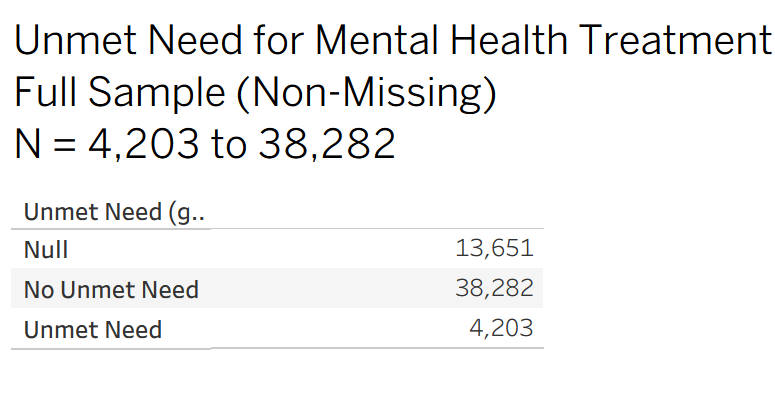
This analysis approaches a deceptively simple question with rigorous statistical methodology: does failing to treat mental health needs result in measurable workforce detachment? Using the 2019 SAMHSA NSDUH dataset, the study isolates 15,780 adults aged 18–25 and tests for statistical dependence between unmet mental health need and employment status.

The hypothesis is that adults reporting an unmet need will have statistically higher odds of unemployment or labor force detachment—controlling for age, sex, race/ethnicity, and education level.

R SQL / PostgreSQL SAMHSA NSDUH Chi-Square Tableau

PRIMARY_VISUALIZATION // UNMET NEED VS EMPLOYMENT

Unmet Mental Health Need by Sex and Employment Status

Unmet mental health need stratified by sex and employment outcome — Chi-Square p < 0.001

METHODOLOGY

The Analytical Framework

  • ASK: Defined the target population: adults aged 18–25, unmet mental health need as exposure, employment status as outcome.
  • PREPARE: Extracted 2019 NSDUH PUF data; renamed raw codebook variables (AMHTXND2, IRWRKSTAT) into readable schema for downstream SQL and Tableau.
  • PROCESS: Built PostgreSQL pipelines to resolve schema drift across survey years and enforce statistical weight integrity.
  • ANALYZE: Executed Chi-Square test of independence on focal cohort (n = 15,780), confirming statistical significance at p < 0.001.

DATA_GOVERNANCE // VARIABLE MAPPING

Raw SyntaxCleaned OutputData Dictionary Rationale
AMHTXND2unmet_needPerceived unmet need for mental health treatment.
IRWRKSTATemployment_statusRevised imputed employment status.
IRWRKSTAT18employment_status_18_plusAge-restricted cohort analysis base.
AMHSVTYPmental_health_treatment_typeType of mental health treatment received.
SPDYRADJserious_psychological_distressStandardized variable mapping across years.
catage / AGEage_groupUnified age categorization across TEDS-A and NSDUH pipelines.
PSYPROBcooccurring_mental_substance_disorderMakes clinical correlation explicit.
EDUCeducation_levelEducation at time of admission/survey.
PRIMINCprimary_income_sourcePrincipal source of income/support.
DETNLFnot_in_labor_force_detailDetail matrix for labor force detachments.

RESULTS ANALYSIS

What The Data Shows Us

  • Contingency & Cross-Tabulation: Within populations with unmet mental health needs, the percentage capable of holding full-time employment drops from ~67% down to ~61%, shifting heavily toward part-time or total unemployment.
  • Chi-Square Test of Independence: Statistically proves (Rejecting the Null Hypothesis) that employment status is intrinsically dependent on mental health treatment accessibility.
  • Modeling Progression: Initial logistic regression failed because both primary vectors were categorical integers with no continuous scale — validating the necessity of Chi-Square over OLS.

TL;DR

Results & Findings

When people do not have an unmet mental health need, the vast majority are securely engaged in full-time work. When people do suffer from an unmet mental health need, the rate of total unemployment and severe workforce detachment spikes substantially relative to population size.

STAT METHOD: Chi-Square Test of Independence
COHORT: n = 15,780 (Adults 18–25) | P-VALUE: < 0.001
INTERPRETATION: Unmet mental health need = measurable, catastrophic workforce detachment.
VIEW RAW GITHUB CODE //